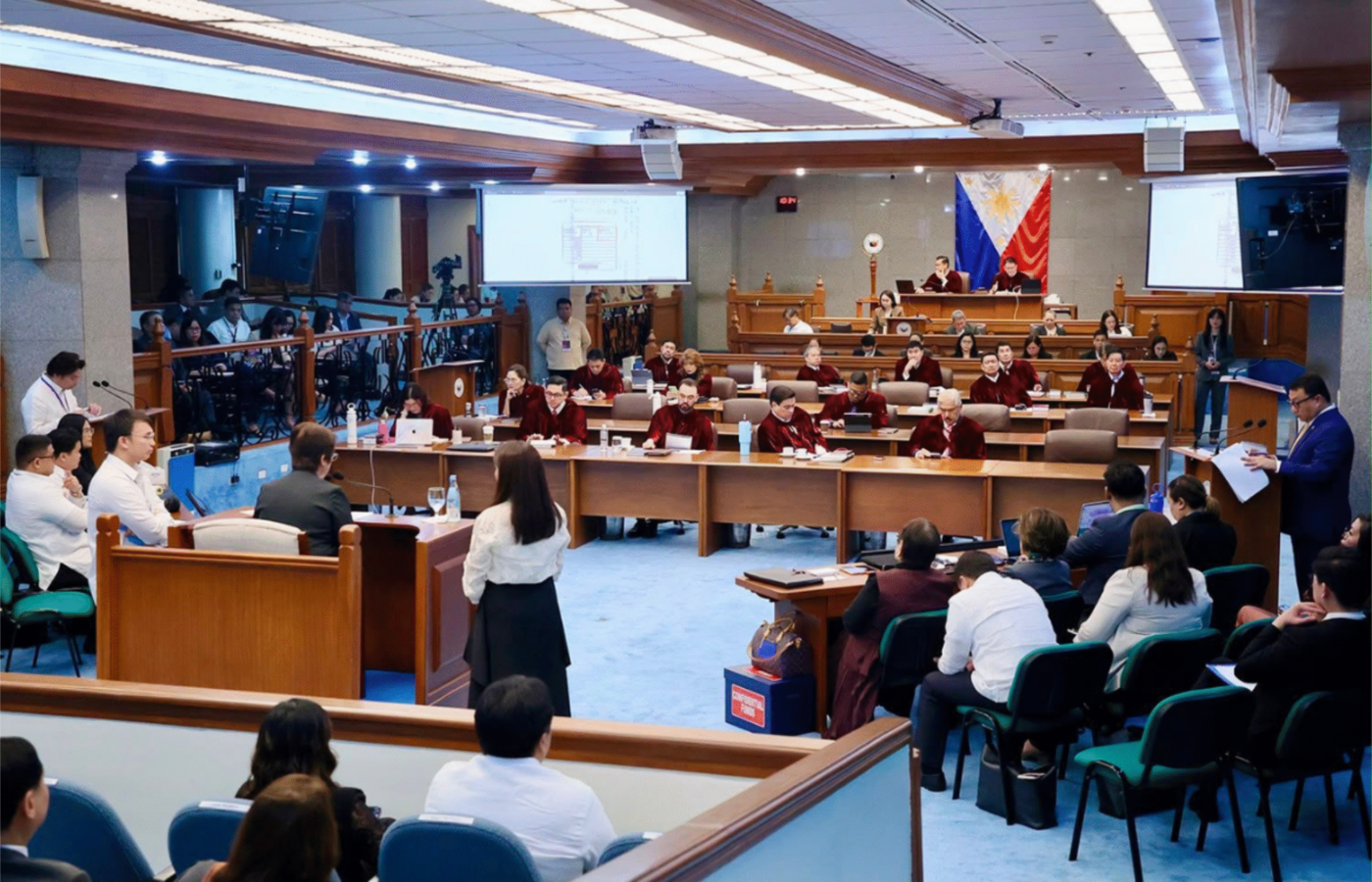
The three questions, the amici, and my opinion
The Senate impeachment court put three questions to retired Chief Justices Hilario Davide Jr., Artemio Panganiban, and Reynato Puno, and retired Associate Justice Adolfo Azcuna. Davide filed a memorandum. The others appeared. What follows is their argument on each question, then my own.
I am not counsel for either panel. I am stating how I read the Constitution and the cases.
Question 1
Does “all the Members of the Senate” in Article XI, Section 3(6) mean twenty-four Senators, or only those legally and physically capacitated to participate and vote on the final question?
The amici
Davide would not count twenty-four as a matter of course. He would compute two-thirds from Senators qualified to vote. Those detained, abroad, suspended, or whose whereabouts are unknown drop out of the phrase. He rests that on the framers’ supposed intent and on decisions holding that public officers facing criminal cases may not, while detained, practice their profession or hold office. On that view the present base is not twenty-four.
Panganiban grants that a literal reading yields sixteen of twenty-four “in the abstract.” He refuses to stop there. Interpretation, he says, cannot be reduced to abstract arithmetic. The tests he offers are truth and fairness. Fairness can be rendered by two-thirds of those present. A Senator who has not heard the witnesses is not in a position to know the truth and should not be used to inflate the denominator.
Puno rejects a standalone literal reading that freezes the number at sixteen. The Charter used a fraction, not the numeral sixteen. A fixed reading, he warns, can produce absurdity and injustice. A contextual and functional approach lets the Senate ask whether the dead, the resigned, the expelled—and those legally incapacitated, including a Senator charged with plunder or under preventive suspension—still belong in the count. The number moves with those facts.
Azcuna is the dissent among the four. “All” means all. As long as a person remains a Member of the Senate, he is in the denominator. The only exits he recognizes are death, removal from office, or resignation. Detention and absence do not end membership. He adds a practical caution: a conviction taken from two-thirds of a reduced base—fifteen of twenty-three, for example—can be attacked as short of the constitutional quantum.
All means all.
My opinion
I agree with Azcuna on the first question.
Article XI, Section 3(6) requires the concurrence of two-thirds of all the Members of the Senate. Article VI, Section 2 composes the Senate of twenty-four Senators. Two-thirds of twenty-four is sixteen. The clause does not say those present, those capacitated, or those who heard the last witness. The American text did. Ours did not.
I start with Bayan v. Zamora, G.R. No. 138570, 10 October 2000. The Court construed the same phrase—“two-thirds of all the Members of the Senate”—in Article VII, Section 21. One seat was vacant. Twenty-three Senators were in office. Eighteen voted to concur. The Court still treated sixteen, two-thirds of twenty-four, as the requirement. I will not give those words a smaller denominator because the present case is impeachment rather than a treaty.
The Senate’s own Rules of Procedure on Impeachment Trials follow that text: conviction or acquittal is measured by two-thirds of all the Members.
Membership ends when the office ends: expiration of the term, death, resignation, expulsion, or other lawful vacancy. Detention, an ICC warrant, medical leave, or concealment may keep a Member out of the hall. They do not vacate the seat. If the Senate is no longer a body of twenty-four, the fraction is taken of the Senate as then constituted. That is the only case in which I would accept a number below sixteen. Four empty chairs are not that case.
I take the force of the other side. Sixteen becomes harder. Fifteen guilty votes fail. That is what a membership supermajority does. Article XI made removal possible and made it hard in the same sentence. I will not honor the first half by deleting the second.
Question 2
Does Avelino v. Cuenco apply in deciding whether Senators who are detained, abroad, suspended, or whose whereabouts are unknown are included in “all the Members of the Senate”?
The amici
Davide treats Avelino as persuasive. In 1949 Senator Confesor was in the United States. The Court, on his account, computed from twenty-three rather than twenty-four, and twelve made a majority. He would extend that treatment to Senators now beyond the Senate’s practical reach.
Azcuna would not. Avelino construed a majority of “the Senate” or “each House” for quorum. It did not construe “all the Members.” On that distinction, he says, the case is not applicable.
Puno does not need Avelino as a holding. His contextual method is enough, in his view, to let the Senate consider Members who cannot function as Members. Panganiban, for his part, spends his force on purpose and fairness rather than on the 1949 caption.
My opinion
I agree with Azcuna. Avelino v. Cuenco, G.R. No. L-2821 (1949), does not decide this vote.
The text before that Court was quorum: a majority of each House. The Court was divided. Some justices computed from those then able to sit after one Senator had left the country. The resolution itself marked the difference I rely on. There is a difference between a majority of all the members of the House and a majority of the House. Article XI, Section 3(6) chose the first kind of language.
Avelino did not construe impeachment. It did not construe treaty concurrence. It did not hold that a living, unejected Senator has ceased to be a Member for a two-thirds vote. Persuasive value is not a holding. The holding that does speak to “all the Members of the Senate” is Bayan. That is the case I would have the court follow.
Question 3
May a senator-judge who did not attend, or did not substantially participate—including by questioning witnesses and observing demeanor—still vote on the final question?
The amici
Davide draws a hard line at total absence. A Senator-Judge who never attended, and never performed the duties of the office, “must be deemed to have never participated.” He puts that person with those outside the country or whose whereabouts are unknown. Partial attendance he leaves to conscience and a sense of duty. Failure to ask questions, he adds, is not itself proof of non-participation. Judges are nonetheless to be present and to hear the witnesses.
Panganiban would go further. A Senator who has not examined the documents, heard the testimony, or watched the witnesses is not in a position to know the truth. Allowing that person to vote, and to swell the count, is unfair to the parties and to the public. If he were in their place, he would inhibit.
Puno will not automatically disqualify a Member for missing portions of the trial. Courts decide on transcripts, affidavits, and the written record. He warns in the other direction as well. An unjustified refusal to let a Member sit as senator-judge can take the case out of the Senate’s exclusive sphere and expose the judgment to review.
Azcuna calls it an internal matter for the Senate. Absent a rule, and in case of doubt, he would allow the vote. This is a tribunal of record. If the Senator can honestly judge the respondent from that record, Azcuna would not shut him out.
My opinion
I separate two questions the argument keeps fusing.
Does the absent Senator remain in the denominator? Yes, if he still holds the office. That is my answer to the first interrogatory, applied here.
May he record guilty or not guilty? The Constitution does not make attendance a condition of the vote. It requires an oath when Senators sit for that purpose. It requires two-thirds of all the Members to convict. It does not say that a Member who missed witnesses is disfranchised. The Senate may adopt a rule under Article XI, Section 3(8). Until it does, I will not invent a participation test and call it constitutional law.
On the limited point that a court of record may be judged from the record, I agree with Puno and Azcuna. Transcripts and exhibits exist for that reason. The 2012 Corona court sat with twenty-three incumbents. Senators who had missed days still answered the roll. The threshold was not recast into a club of those who had heard every witness.
I will not pretend that an uninformed vote keeps the oath. The oath is to do impartial justice. A Senator who has not mastered the record and votes from faction alone is not keeping it. Davide’s appeal to conscience and Panganiban’s appeal to inhibition are counsel to the voter. I accept them as counsel. I do not accept them as a rewrite of the membership count.
I also accept Puno’s institutional warning as he stated it. Locking a Member out of the vote, without a rule and without a lawful end of the office, is the kind of act that can convert a Senate question into a constitutional defect. A preference for a lower number is not that lawful ground.
What I would have the court do
On the first question, keep the July ruling. Sixteen, while there are twenty-four Members.
On the second, decline to treat Avelino as the measure of conviction.
On the third, allow a Member who still holds the office to answer the roll, unless the Senate first adopts a valid rule on participation and applies it in the open. Regulate the vote if the Senate wishes. Do not manufacture a vacancy in order to change the fraction.
The amici have given the court a division worth studying. My own view is narrower.
Membership is the denominator. Attendance is a duty.
The Charter made the first of those the measure of conviction. I would not substitute the second.
Background: Kenneth Christiane Basilio, “Impeachment trial shifts to VP’s spending,” Philippine Daily Inquirer, 3 August 2026 — on the prosecution’s presentation of Commission on Audit witnesses under the second article of impeachment.